Across China: China brings arts criticism to public squares as communities reshape folk traditions

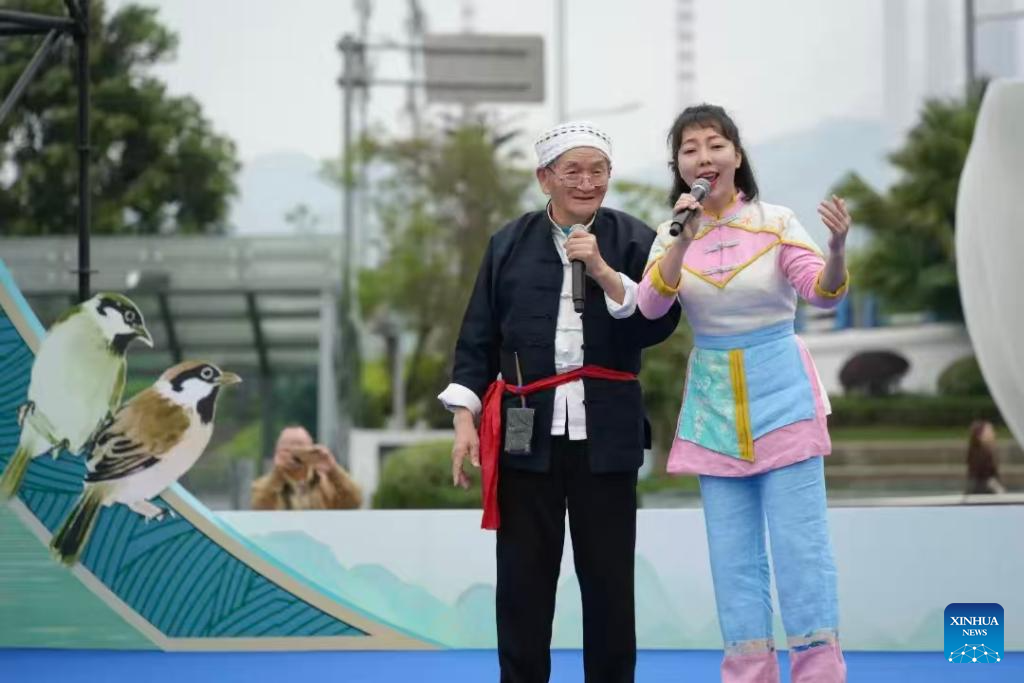
Representative inheritors of Mudong mountain songs, listed as part of China's national intangible cultural heritage, perform during an event in Banan District of Chongqing Municipality, southwest China, March 27, 2026. (Xinhua)
CHONGQING, April 15 (Xinhua) -- On a spring morning in a public square in southwest China's Chongqing Municipality, a performance of traditional mountain songs turned into a lively debate.
One audience member, seemingly in his 50s or 60s, said the rhythm was too fast for farmers to sing while working. A woman of a similar age countered that people her age enjoyed square dancing, and that faster tempos could help the songs reach a wider audience.
This exchange formed part of "Sparrow Art Reviews," a grassroots cultural initiative that is taking arts criticism beyond academic circles into everyday community spaces.
Launched in 2017 in Chongqing's Banan District, the program has held more than 600 events and engaged over 300,000 participants, according to organizers.
Designed to address the perception that arts criticism is "lofty and detached" from everyday life, the initiative moves discussions out of academic settings and into neighborhood squares, village courtyards and community centers, using plain language instead of technical jargon. Participants are encouraged not only to watch performances but also to comment on lyrics, melody, staging and cultural relevance, often resulting in sharply differing views.
"Everyone speaks from their own experience and says what they think," said Zhao Shenzhu, vice chairwoman of the Henan Provincial Literary and Art Critics Association. "That kind of atmosphere, where voices contend freely and everyone evaluates together, brings arts criticism down from the ivory tower into everyday life."
REVIVING TRADITION VIA PUBLIC VOICES
China has listed more than 1,500 items of intangible cultural heritage on its national registry since 2006, many of which face declining transmission as younger generations move to cities, among other factors. Initiatives like "Sparrow Art Reviews" are increasingly being used to address this challenge.
Mudong mountain songs, a local folk tradition rooted in the labor rhythms of rice cultivation along the Yangtze River and listed as part of China's national intangible cultural heritage in 2006, have gained renewed attention through such events.
Qin Qiuyue, a representative inheritor of Mudong mountain songs intangible cultural heritage, said the forums had opened up new directions for her work.
"Their suggestions were valuable," she said. "They made me think about how to make Mudong mountain songs fit people's everyday lives and get more people not just to listen, but to take part."
Suggestions from attendees have ranged from integrating the songs into short videos and mobile games to adapting their rhythms for square dancing.
The approach is also filtering into classrooms. Xu Daoquan, a music teacher, encourages students to comment on folk songs during lessons, making classes more interactive. A curriculum he helped develop has since been introduced across the district.
Traditional crafts are also finding new audiences. Wang Hua, an inheritor of Yudong random stitch embroidery, said the public forums have changed how she engages with her work.
"The first time I took part, I was very nervous," she said. "I didn't expect the audience to respond so warmly to my work." She added that the experience helped her become more confident in both practicing and explaining her craft, while also helping to attract younger apprentices.
FROM CULTURAL POLICY TO COMMUNITY CHANGE
Chinese authorities have in recent years stepped up efforts to expand public cultural services and promote a people-centered approach to cultural development. Grassroots initiatives such as "Sparrow Art Reviews" are seen as a way to enrich cultural life while improving public appreciation of the arts.
The program typically combines performances, expert commentary and open discussion, allowing professional critics and ordinary citizens to engage on the same platform.
Yuan Yan, an associate researcher at the Jiangxi Academy of Social Sciences in east China, said the model reflects a form of cultural participation in which non-professional voices are given full respect.
Beyond the arts, organizers say the initiative is reshaping community life.
In Dongwenquan Town, residents who once spent leisure time playing mahjong now gather for waist drum performances and square dancing after attending the sessions. Some groups have gone on to develop original programs and take part in local competitions.
The initiative highlights a broader challenge facing China and beyond: how to preserve traditional culture while keeping it relevant to contemporary life.
For performers, feedback from audiences can be immediate and sometimes contradictory. For participants, it offers a rare opportunity to influence how artistic traditions evolve.
Building on the success of "Sparrow Art Reviews," districts and counties across Chongqing have established their own literary and art critics associations, each developing what officials describe as a distinctive local model of community arts engagement.
Critics, said Xu Yuechun, vice chairman of the China Literature and Art Critics Association, should play a greater role at the grassroots level and help improve public appreciation of the arts. ■


